
Smart Manufacturing in Automotive: Deployment and Impact
Download NowFull Description:
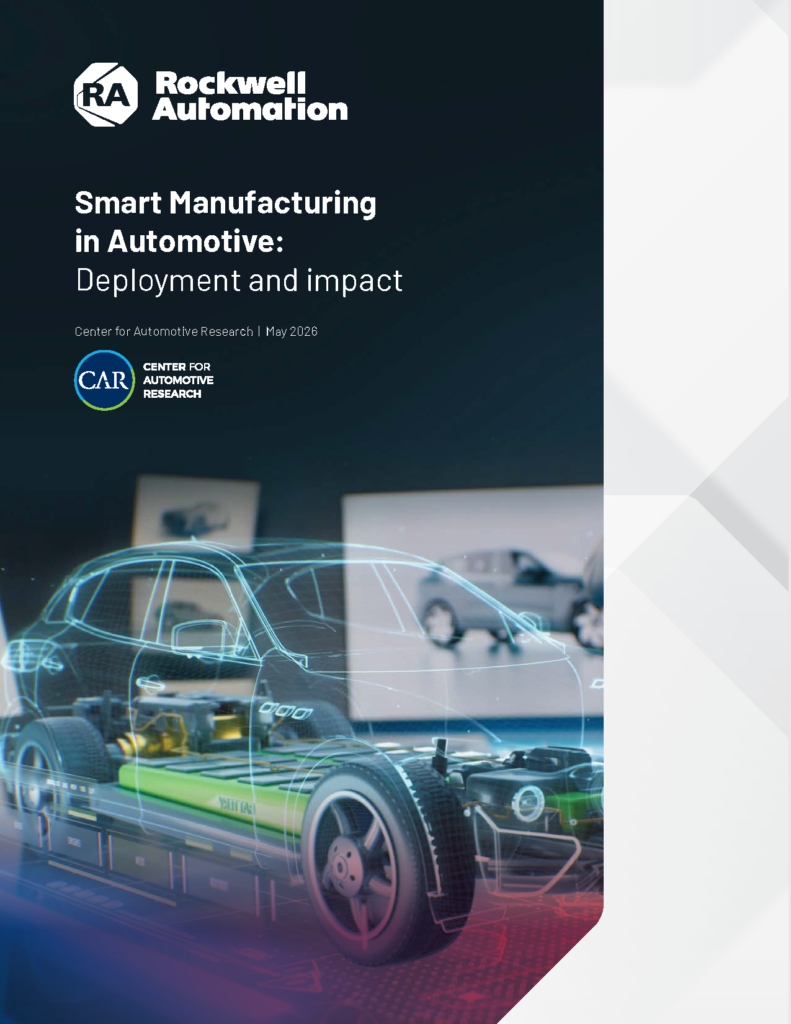
Smart Manufacturing in Automotive: Deployment and Impact
The automotive industry is entering a new phase of AI/machine learning (ML) and automation. The question for manufacturers serving the automotive, tire, and battery markets is no longer whether to adopt, but how quickly and where to put smart manufacturing to work, according to Center for Automotive Research (CAR) analysis.
Automakers and suppliers already operate with industry-leading automation, particularly in body, paint, and welding. What is changing is where it’s applied. Manufacturers globally are moving into areas that have historically been harder to automate, including electronics assembly, validation, production coordination, and logistics. AI/ML is simultaneously improving predictive maintenance, inspection accuracy, and system performance across existing operations.
The drivers are clear: more complex production environments, persistent warranty issues, rising commodity costs, and global competition are leaving less room for late-stage fixes and reactive management. Automation is also enabling onshoring by supporting cost-competitive production under tight labor market conditions.
The results are measurable. Manufacturers reported reductions in unplanned downtime of up to 50% in select applications, overall equipment effectiveness (OEE) improvements of approximately 5%, and throughput gains of 5–7% from real-time production analytics. Autoliv’s productivity acceleration, from roughly 4% in 2023 to over 9% in 2025, is one of the more concrete indicators of what sustained investment can deliver, in CAR’s view. Putting this into perspective, Durable Goods Manufacturing averaged just 2.7% productivity growth in 2025, while Motor Vehicle Parts (NAICS 3363) data through 2024 ranged from 2.6% to 5.9% annually.
The impact is already visible on the plant floor. Teams using advanced AI/ML technologies are identifying issues earlier, reducing downtime, and improving process consistency across plants. These gains, however, are not uniform. Differences in how companies embrace smart manufacturing, particularly in quality, uptime, and process controls, are beginning to separate higher and lower-performing manufacturers and suppliers, according to CAR research.
Leading companies are extending these capabilities across plants and process functions, and they are increasingly expecting the same of their suppliers. The industry and supply base are also developing gaps that carry strategic implications for sourcing, program execution and long-term competitiveness.
https://www.rockwellautomation.com/en-us/industries/automotive-tire/smart-manufacturing-automotive-whitepaper.html
Download Now