Why the Next Frontier of Automotive Value Is the Enterprise Workflow.
The industry that perfected optimization has run out of silo
No industry on earth understands process optimization the way the automotive industry does. From the Toyota Production System to lean, kaizen, and their many descendants, OEMs have spent the better part of a century turning the disciplined elimination of waste into a core competency.
But that era is reaching its natural ceiling.
When we say OEMs have optimized locally, we do not mean geographically. We mean within a function. And these functions are not small. A single one, such as indirect procurement or aftermarket parts, may span 800 suppliers across 17 countries. Optimizing a footprint that large is itself a staggering achievement — one OEMs are rightly proud of.
The problem is that the value left inside each function is now largely squeezed dry. The next tranche of value no longer lives within the silos. It lives in the white space between them.
From within-function excellence to enterprise workflows
For decades, the function was the unit of excellence. Quality owned quality. Supply chain owned supply chain. Each was measured, incentivized, and optimized against its own local targets — and each got very good at hitting them.
But an OEM’s value is created across functions, not inside them. The customer, the part, the supplier, and the cash never respect the org chart. The next frontier is a different axis entirely: horizontal, end-to-end enterprise workflows cutting across engineering, procurement, quality, logistics, and finance.
The product itself is forcing the issue. The IBM Automotive 2035 research projects digital and software-related revenue rising from roughly 15% of industry revenue today to over half by 2035. A software-defined vehicle cannot be built, sold, and serviced by a function-defined enterprise.
This is not a technology statement. It is an operating-model statement. The right to deploy technology is earned only after the underlying policies and business processes have been rethought — who owns what, how value is measured, where decision rights sit. Get the sequence wrong, and you simply automate a broken hand-off faster.
Once workflow and policy are redesigned, the technology follows, applying a consistent discipline to every step:
- Eliminate — remove steps the redesigned workflow no longer needs
- Simplify — strip complexity from what remains
- Automate — standardize the simplified step, then automate it
- Agentic — deploy AI agents to carry cross-functional work to completion
The burning platform: New benchmarks already set
None of this is theoretical urgency. The benchmark has already moved.
Chinese automakers now take a new vehicle from concept to start of production in roughly 24 months — against 45 for a mass-market Western OEM and 53 for a premium one. That is not an efficiency gain; it is a different category of company — roughly twice the speed, with bill-of-materials and capital costs on the order of 30% lower.
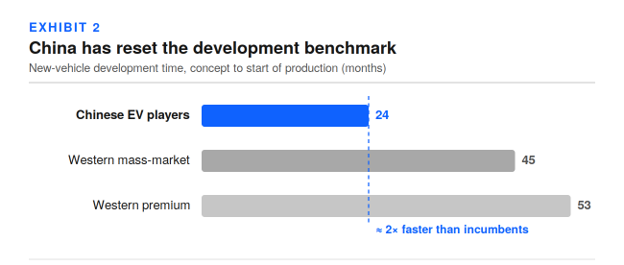
Speed at that magnitude compounds: two product generations, and two cracks at the market, for each of a slower rival’s one.
Crucially, much of the advantage is structural rather than improvised: concurrent engineering, deep vertical integration, radically tighter supplier ecosystems. And the hard part for every established player: the gap must be closed on brownfield, not greenfield. The newer entrants never carried the legacy structures in the first place.
What “end-to-end” actually looks like: the aftermarket
The idea of an enterprise workflow can stay abstract, so consider one that every OEM feels but almost no one owns end-to-end: the aftermarket.
The as-is is perfectly rational, highly functional, and thoroughly siloed. A single failed part can arrive through three different front doors — an end customer, an independent workshop, a dealer — each requiring different evidence. Warranty sits in quality. Parts planning sits in supply chain. Distribution across parts and vehicle distribution centers sits in logistics. Supplier cost recovery sits somewhere else again. Every one of these is locally optimized, hitting its targets.
Yet value leaks in the seams: expedited freight to cover a demand miss planning never saw; warranty leakage because supplier-fault signals never loop back into forecasting; working capital tied up in the wrong parts at the wrong node. No single function is failing. The workflow is.
The to-be is one orchestrated, end-to-end flow: a warranty signal feeds demand sensing; demand sensing repositions inventory at the right node; the same signal flags the responsible supplier for recovery; and the chain is measured against a single service and cost outcome rather than four local ones.
The technology to do this exists. What unlocks it is policy reform: defining who owns the aftermarket P&L, establishing shared data rights, and replacing four local service-level targets with one end-to-end definition of success.
Reform the process, then deploy the agent
Redesigning an enterprise workflow sounds clean on a slide. In practice, the hard part is rarely the AI model. It is the unglamorous work underneath: mapping how a cross-functional process actually runs, extracting the operating logic buried in thousands of procedures, and grounding any agent in the enterprise’s own data, rules, and context before it is allowed to act.
That groundwork is now itself AI-assisted: agents can read thousands of procedures, extract the logic they encode, and convert legacy processes into agent-ready workflows grounded in the enterprise’s own data. In one recent engagement, analyzing roughly 1,400 procedures surfaced more than 1,000 improvement opportunities and a projected operating-cost reduction north of 25% within 18 months. But tooling matters less than sequence: re-understand the process, reform the policy, then orchestrate.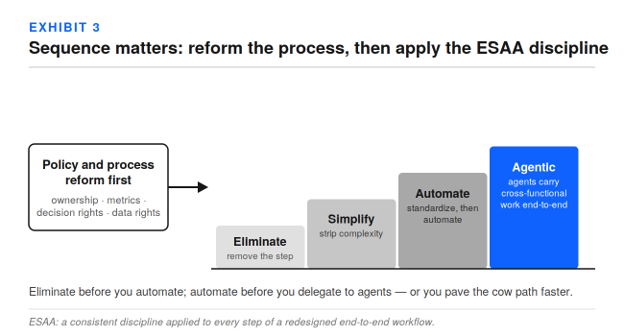
The new focus: people and skills
An enterprise-workflow transformation is ultimately a people transformation. This is where OEMs face their most delicate challenge.
The industry has world-class talent in the disciplines it has always needed: industrial engineering, manufacturing, R&D. But cross-functional workflow transformation demands data fluency and process orchestration across the enterprise and that capability barely exists outside the plant and the engineering center, because it was never required.
The industry’s own leaders concede the point. In the Automotive 2035 research, roughly three-quarters of executives acknowledged their organizations remain rooted in a mechanical-driven culture, and the talent needed for the transition is not expected to be fully in place until 2034. That is not a skills gap; it is a decade-long skills race that has already started.
There is a deeper, human dimension underneath. Working for an OEM was historically a hard, physical life, and the protections and rigid job structures that grew up around it were a fair compact for demanding work. But as robotics stripped out the physical burden — and agentic AI begins to absorb cognitive-routine work — the work itself has changed. When work changes that profoundly, the compact built around it deserves an honest revisit.
The framing is unambiguous: this is not about elimination of people. It is about redeployment of human capital — elevating a capable, loyal workforce toward the higher-value, cross-functional work the enterprise now needs most. The work changed; the skills must change; and the social compact must evolve with them.
The path forward
The automotive industry did not become the world’s benchmark for operational excellence by standing still, and it will not defend that position by optimizing silos that are already optimized. The next decade of value belongs to the OEMs willing to redraw the workflow across the enterprise, reform the policies that hold the old structure in place and bring their people with them.
Meet the Author:

Nic Cieslak — Partner, IBM Consulting
Nic is a Partner with IBM Consulting, where he leads enterprise workflow transformation programs for several of the world’s largest automotive manufacturers. His work spans operating-model redesign, AI governance, and delivery leadership on complex, multi-month transformation engagements. He writes and speaks on how established OEMs can unlock enterprise-level value on brownfield operations.
